
BioMe Soakaway Regenerator, Bacteria to Restore a Soakaway 600 g
Biological regenerator for a soakaway: a vertical pit of concrete or plastic rings, filled with gravel. A mineral carrier takes Bacillus bacteria and five enzymes to the bottom and walls of the soakaway, where the biomat blocks the pores in the soil.
- For soakaways only: there are dedicated regenerators for drainage fields and tunnels
- Treatment: 600 g dissolved, poured straight into the soakaway
- Prevention: 150 g every 3 months
Looking for this product for your business?
We sell wholesale, to distributors and under your own brand. Tell us what you need and we will prepare an offer.
Request a wholesale offer- Manufacturer with its own laboratory
- Wholesale, private label, distribution
- Shipping from Poland across Europe
- SoakawayFor a vertical pit of concrete or plastic rings
- Mineral carrierThe granules sink to the bottom of the soakaway, where the clogging is
- 5 active enzymesBreak down fats, proteins, starch and fibre
- Prevention every 3 months150 g after regeneration, into the soakaway or down the toilet
Soakaway no longer taking the water? Don’t start digging yet.
For the soakaway of a domestic treatment plant: a vertical pit made of concrete or plastic rings, filled with gravel, through which treated water passes into the soil. A mineral carrier takes Bacillus bacteria and five enzymes to the bottom and walls of the soakaway, where the biomat has blocked the pores in the soil. No tanker, no digging, no new rings.
- Soakawayvertical, concrete or plastic
- Straight through the lidpour the solution in, no digging
- 5 active enzymesfor fats, proteins, starch and fibre
- 600 g = 1 treatmentor 4 prevention doses of 150 g
The water in the soakaway sits higher and higher and won’t go down
A soakaway covers only a few square metres, so its whole absorption surface is concentrated in one spot. The biomat settles on the walls, in the gravel around the rings and on the bottom, where it forms a watertight layer. The first signs often appear when the problem is already advanced.
- Water stands higher in the soakaway than usual
- Wastewater backs up into the chamber or treatment tank
- A wet patch on the lawn around the soakaway
- A smell from the soakaway lid
Mechanical cleaning only removes the top layer, and a tanker empties the tank but doesn’t clear the soakaway. Harsh chemicals kill the bacteria in the treatment plant, and untreated water speeds up clogging.
The granules sink to where the blockage is
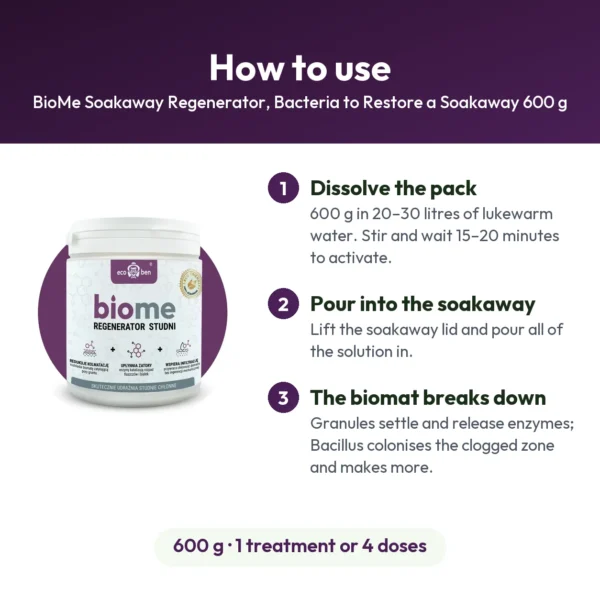
Dissolve the pack
600 g in 20–30 litres of lukewarm water. Stir and wait 15–20 minutes to activate.
Pour into the soakaway
Lift the soakaway lid and pour all of the solution in.
The biomat breaks down
Granules settle and release enzymes; Bacillus colonises the clogged zone and makes more.
Which BioMe product suits your system
All four break down the biomat with Bacillus bacteria and enzymes. Each regenerator is made for one type of infiltration system only and has a mineral carrier that takes the granules to the bottom of the system.
Soakaway
A vertical pit made of concrete or plastic rings, filled with gravel. That’s BioMe Soakaway Regenerator.
Classic drainage field
A flat network of perforated pipes laid in gravel under the lawn. Choose BioMe Drainage Field Regenerator.
Infiltration tunnels
Arch-shaped chambers made of perforated plastic. Choose BioMe Infiltration Tunnel Regenerator.
Blocked pipes and drains
An unblocker you dissolve in warm water and pour in through the distribution box. Choose BioMe Drain Unblocker.
One treatment, then prevention every 3 months
Treatment
- Dose
- the whole pack (600 g)
- Water
- 20–30 l, lukewarm
- Pause
- 24 hours with no wastewater
Prevention
- Dose
- 150 g
- How often
- every 3 months
- How
- in 5–10 l of water, straight into the soakaway, or down the toilet
Apply in the evening, before night-time or before you go away. The 24-hour pause is essential: the bacteria need contact with the deposits without being flushed away by fresh wastewater. Don’t pour the treatment dose down the toilet: that many undissolved granules can block the U-bend.
Don’t use hot water: above 30°C the bacteria and enzymes lose their activity. Don’t pour the dry powder straight into the soakaway. On the day of application and for 48 hours afterwards, keep chlorine, gas boiler condensate and water softener brine to a minimum.
What this product won’t do
It won’t repair a damaged soakaway
Cracked rings, perforations blocked by hardened hard-water salts or a bottom compacted over years can’t be fixed biologically.
It won’t work in a few hours
The first results usually show within 7–14 days, the full effect within 4–6 weeks.
It isn’t for drainage fields or tunnels
For those, there’s BioMe Drainage Field Regenerator and BioMe Infiltration Tunnel Regenerator.
What our customers ask
What is a soakaway and how is it different from tunnels?
A soakaway is a vertical structure made of concrete rings or plastic units, filled with gravel. Treated water enters the soakaway and passes into the soil through perforations in the walls and through the bottom. A soakaway has a concentrated absorption surface of a few square metres. Tunnels have a horizontal surface spread over 10–30 m². A soakaway is practical on small sites, but it is more prone to clogging.
How quickly will I see a difference?
The first results usually show within 7–14 days: the water level in the soakaway drops and water drains better from the house. The full effect comes within 4–6 weeks. If the soakaway was already overflowing, some of the surrounding soil may have compacted permanently, and the effect is partial.
Should I keep using it after the regeneration?
Yes, if you want the effect to last. Every batch of wastewater carries new fats, slime and organic particles into the soakaway. The prevention dose is 150 g every 3 months, so 4 times a year.
Can I dose it down the toilet?
The prevention dose (150 g), yes: pour it down the toilet in the evening and flush, and the bacteria pass through the treatment tank into the soakaway. The treatment dose (600 g), no: dissolve it in 20–30 litres of water and pour it straight into the soakaway through the lid.
What weakens the product?
Chlorine (bleach, chlorine toilet gels, disinfectants), acidic condensate from a gas boiler (pH 3–5) and brine from water softener regeneration. On the day of application and for the following 48 hours, keep them out of the drains as much as possible.
What if I see no improvement?
If nothing changes 6 weeks after the full dose, the problem isn’t just biological: cracked or settled rings, very impermeable clay soil, a soakaway too small for the household, the system’s biology destroyed by chemicals, or a water table very close to the surface. In that case, ask the company that installed your system for a diagnosis.
Everything you need to know
Ingredients
Sodium chloride (mineral carrier), non-pathogenic Bacillus bacteria (GRAS status), maltodextrin, enzymes (alpha-amylase, alkaline protease, neutral protease, cellulase, lipase), lemon fragrance, trace elements. Beige-brown granular powder, lemon scent with a faint note of fermentation, pH 5–8, fully water-soluble, fully biodegradable.
Storage
- In the original pack, tightly sealed, somewhere dry (up to 25°C)
- Away from moisture: damp activates the bacteria inside the pack and shortens shelf life
- Away from sunlight and strong oxidisers (acids, hydrogen peroxide, chlorine products)
- Out of reach of children
- Once opened, use within 24 months
CLP classification and precautions
This product is not classified as hazardous under CLP (EU 1272/2008). Contains enzymes: may produce an allergic reaction in sensitive people. Avoid raising dust when measuring and wash your hands after use.